

Coffee Swiss Roll
This coffee Swiss roll pairs a soft coffee chiffon cake with a light coffee whipped cream, then rolls both into one tidy swirl. Espresso powder goes into the cake and into the filling, so the coffee flavor comes through clearly without turning the dessert heavy.

The cake is airy, the cream is barely sweet, and each slice feels light rather than rich. The recipe makes 8 slices, with about 1 hour 20 minutes of prep, 13 to 14 minutes in the oven, and at least 3 hours of chilling.
Jump To
Notes from the baker
I have baked a lot of roll cakes over the years, and coffee was the flavor I kept circling back to. My family asks for the chocolate version at every birthday, but the coffee one disappears fastest at weekend breakfasts, usually before the second pot finishes brewing. So it felt like time to write this one down properly.
This roll uses the same soft, plush cake and the same airy whipped cream filling as my other roll cakes, with a fragrant coffee flavor added to both layers. I keep coming back to Swiss rolls because they are easier than layer cakes.
You need one baking tray for one cake sheet instead of several round pans, and the cake is rolled up with whipped cream rather than frosted in layers.
The ratio of cake to cream is exactly what I want in a slice, generous enough to taste creamy, light enough that a second piece is never a problem.
Why you’ll love this recipe
Here is what makes this coffee roll worth baking on a quiet Sunday afternoon.
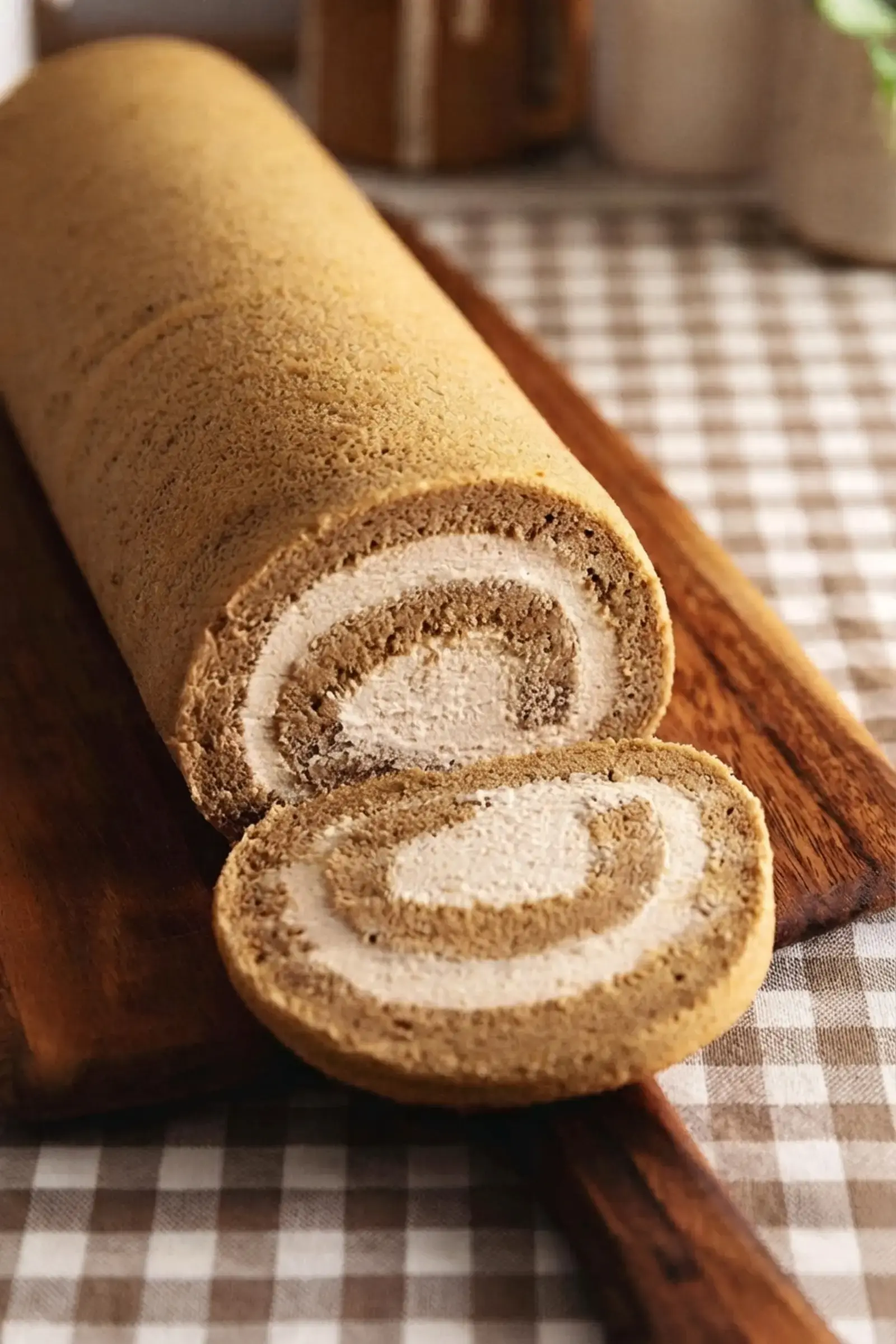
- The chiffon cake rolls without drama. It is soft enough to bend without cracking or ripping, and it has the plush texture I look for in the roll cakes sold at Asian bakeries.
- The filling stays light. Whipped cream, not buttercream, so it tastes airy and not too sweet, and it never sits heavy on the tongue the way a thick frosting can.
- Coffee shows up twice. Espresso powder flavors the cake and the whipped cream, which gives a rounded coffee taste instead of a faint hint.
- It keeps well. There is no butter in the cake, so it stays soft even when served cold straight from the fridge.
- It is a good make ahead dessert. You can bake and fill it the day before, let it chill overnight, and slice it the next day when you are ready to serve.
Tools
You do not need much equipment here, but three things genuinely matter.
- A 12×17 inch baking tray. The kind you use for cookies is perfect. A similarly sized pan or a jelly roll pan works too, as long as the walls are at least 1 inch tall, so the batter has room to climb.
- An electric hand mixer or a stand mixer. You will use it to whip the egg whites into a meringue and to whip the cream to stiff peaks. Doing either by hand is possible, but it takes patience.
- An offset spatula. This is the tool that spreads the batter evenly into the corners of the tray and smooths the whipped cream across the cake sheet. It also tidies the edges when you roll.
Parchment paper, a wire rack, and plastic wrap round out the list.
Ingredient notes
The full recipe card with amounts and instructions sits at the end of this post. Before you start, here is what each ingredient is doing, because a few small choices make a real difference in a roll cake.
| Ingredient | Amount | What it does |
|---|---|---|
| Eggs | 6 large, room temperature | Separated. The whites become the meringue that lifts the cake, the yolks build the base. |
| Cream of tartar | 1/4 teaspoon | Stabilizes the egg whites and helps them whip faster. |
| Granulated sugar | 150 g, divided into 100 g and 50 g | The larger portion goes into the whites, the smaller portion into the yolks. |
| Milk | 50 g | Dairy or plant based, such as oat or almond milk. |
| Oil | 50 g | A light tasting neutral oil, such as canola, avocado, or grapeseed. |
| Vanilla extract | 1 teaspoon | Rounds out the coffee flavor in the cake. |
| Cake flour | 110 g | Less gluten than all purpose flour, which keeps the cake light and fluffy. |
| Espresso powder | 2 tablespoons | The coffee flavor in the cake. |
| Baking powder | 1/2 teaspoon | A safeguard in case the meringue does not rise as far as you hoped. |
| Whipping cream | 400 g, cold | The filling. Keep it cold so it whips quickly and holds its shape. |
| Powdered sugar | 40 g | Sweetens the cream without any graininess. |
| Espresso powder | 1 1/2 teaspoons | The coffee flavor in the filling. |
| Vanilla extract | 1 teaspoon | Softens the coffee edge in the cream. |
Eggs. Let them come to room temperature before you begin. Warm whites whip faster, and separated yolks blend more smoothly into the batter.
Cream of tartar. This acidic powder stabilizes the whites and helps them reach stiff peaks sooner. A splash of vinegar or lemon juice works as a substitute, and leaving it out is fine too.
Sugar. Measure it into two bowls ahead of time, 100 g for the meringue and 50 g for the yolks, so you are not measuring while the mixer runs.
Milk and oil. Any milk works, dairy or plant based, including oat and almond milk. Choose a light tasting neutral oil such as canola, avocado, or grapeseed so it does not compete with the coffee.

Cake flour. It contains less gluten than all purpose flour, which is what keeps the cake tender and fluffy.
Espresso powder. Use instant espresso powder that dissolves in water, never ground espresso beans. It flavors the cake and the cream without adding extra liquid. Instant coffee works as a substitute, though espresso powder tastes stronger.
Baking powder. The whipped whites are the main leavener. The baking powder is a safeguard so the cake still rises if the meringue is not at its best.
Cream. Whipping cream is the standard choice, and heavy cream gives a slightly richer filling. Keep it cold until the moment you whip it.
Tips for making the best coffee swiss roll
A roll cake is forgiving once you know the few moments that matter. These are the steps I follow, and the reasons behind them.

- Start with the oven and the tray. Preheat to 350°F and line your 12×17 inch tray with parchment paper cut to size on the bottom only. Leaving the sides bare helps the batter grip as it climbs.
- Separate the eggs with clean hands. Even a little yolk or oil in the whites keeps them from whipping properly, and there is no way to rescue a bowl that has been contaminated. Crack each egg into a small separate bowl first, then lift the yolk with clean fingers and let the white slip through into the mixing bowl. That way one broken yolk never ruins the batch, and you avoid puncturing the yolk on a sharp shell edge.
- Whip the whites to stiff peaks. Add the cream of tartar, beat on low to medium speed until the whites look frothy like cappuccino foam, then add the 100 g of sugar one spoonful at a time, mixing between each addition. Finish on medium high until the meringue holds stiff peaks. Lift the beaters: the peaks should stand up and curl gently at the tips. If they droop, keep going. Avoid the very highest speed, because it whips in large air bubbles that collapse in the oven and leave a flatter cake.
- Build the yolk batter. Mix the yolks with the remaining 50 g of sugar, then add the milk, oil, and vanilla. Sift the cake flour, espresso powder, and baking powder into the bowl through a fine mesh sieve, then mix on low just until the flour disappears. Overmixing at this stage makes a tougher cake.
- Fold, do not stir. Add about a third of the meringue to the yolk mixture and fold with a spatula, scraping the bottom of the bowl as you go. Add the rest and fold until no streaks remain. Thick batter likes to hide at the bottom and sides, so check there too.
- Spread and bake. Pour the batter into the lined tray and use the offset spatula to ease it into the corners and level the top. Bake for 13 to 14 minutes, until the edges are lightly browned and the surface looks puffed.
- Pre roll while the cake is warm. Let the cake cool on a wire rack for only about 5 minutes, then run the offset spatula around the edges to release it. Top with a rack, flip the cake out with oven mitts, peel off the parchment, lay a fresh sheet on top, and flip it back. While it is still warm, roll the cake up with the parchment starting from a short end and let it cool completely in that rolled shape. Rolling it warm trains the cake to hold the curve, which is the best insurance against cracks and rips later.
- Fill and roll again. Whip the cold cream with the powdered sugar, espresso powder, and vanilla until stiff peaks form. Unroll the cooled sheet, drop spoonfuls of cream over the surface, and spread a thick even layer with the offset spatula, leaving the last 1 inch at the far end bare. Roll it up the same way as before, finishing onto a sheet of plastic wrap so you can wrap it right away. Smooth away any cream that pushes out of the seam and use the leftovers to fill the ends.
- Chill before you slice. Wrap the roll and refrigerate it for at least 3 hours, or overnight. This rest lets the cream set so it holds a clean swirl. Slicing too early squishes the filling out the sides and lets the cake slip around. When you are ready, use a serrated knife to trim about 1/2 inch off both ends to show the spiral, then cut slices about 1 to 1.5 inches thick.
Give the roll at least 3 hours in the fridge before slicing. That rest is what makes a clean swirl possible.
Storage
Keep the roll covered or in an airtight container in the refrigerator, where it stays good for up to 5 days.
Because there is no butter in the cake, it stays soft even when you serve it straight from the fridge, so there is no need to let the whole roll come to room temperature.
If you would rather not serve it fridge cold, give each slice about 15 minutes on the counter first.
For longer storage, freeze leftovers for up to 1 month. Wrap the roll well in plastic wrap, aluminum foil, or an airtight container, then thaw it overnight in the refrigerator before serving.
More Cakes
If you enjoy this style of light, rollable cake, keep exploring the cake recipes on the blog. There are plenty of other bakes built on the same soft crumb and gentle sweetness, and they come together with the same simple tools.
FAQs
Why did my coffee Swiss roll crack and how can I prevent it?
Cracks typically happen when the cake is overbaked, making it too dry, or when the egg white meringue is overmixed, creating fragile air bubbles. To prevent cracks, bake the cake sheet for only 13-14 minutes at 350°F and pre-roll it while it is still warm after about 5 minutes of cooling to train the sponge into shape.
Can I use instant coffee instead of espresso powder in this coffee Swiss roll?
Yes, instant coffee can be used as a substitute for espresso powder. However, for the best deep coffee flavor, instant espresso powder is preferred because it is less acidic and dissolves easily. When using instant coffee, you may need to use a slightly larger amount to achieve a comparable coffee taste.
How long does a coffee Swiss roll last in the refrigerator and can it be frozen?
A coffee Swiss roll can be stored covered in the refrigerator for up to 5 days, and the cake will remain soft due to the use of oil. It can also be frozen for up to 1 month; wrap it tightly in plastic wrap and thaw it overnight in the refrigerator before serving.
How do I slice a coffee Swiss roll cleanly without squishing the cream?
To slice cleanly, use a sharp serrated knife and wipe it clean between each cut. For the best results, chill the rolled cake for at least 3 hours or overnight to fully set the whipped cream before slicing, which helps maintain a neat swirl and prevents the cream from squishing out.

Coffee Swiss Roll
Coffee Swiss Roll This coffee Swiss roll pairs a soft coffee chiffon cake with a light coffee whipped cream, then rolls both into one tidy swirl. Espresso powder goes into the cake and into the filling, so the coffee flavor comes through clearly without turning the dessert heavy.
- Total Time: 274 min
- Yield: 8 slices 1x
Ingredients
Coffee Chiffon Cake
6 large eggs eggs, room temperature
1/4 teaspoon cream of tartar
150 g granulated sugar, divided into 100g + 50g
50 g milk, dairy or non-dairy
50 g oil, e.g. canola oil
1 teaspoon vanilla extract
110 g cake flour
2 tablespoons espresso powder
1/2 teaspoon baking powder
Coffee Whipped Cream
400 g whipping cream, cold
40 g powdered sugar
1 1/2 teaspoon espresso powder
1 teaspoon vanilla extract
Instructions
Coffee Chiffon Cake
1-Preheat oven to 350°F: Preheat oven to 350°F. Line a 12×17″ baking tray with parchment paper cut to size on the bottom only and set aside.
2-Separate the egg whites and egg yolks: Separate the egg whites and egg yolks into two large mixing bowls, being careful not to get any yolk in the egg whites. Set the bowl of egg yolks aside.
3-To the egg whites, add cream of: To the egg whites, add cream of tartar. Use an electric hand mixer to beat the egg whites on low-medium speed until they become frothy like cappuccino foam. Add 100g of sugar, one spoonful at a time, mixing in between each addition. After all the sugar has been added, continue beating on medium-high speed until the meringue becomes stiff peaks. Set aside.
4-To the egg yolks, add the remaining: To the egg yolks, add the remaining 50g of sugar. Use the same hand mixer to mix until combined. Add the milk, oil, and vanilla extract and mix until combined.
5-Hold a fine mesh sieve above the: Hold a fine mesh sieve above the mixing bowl and add in the flour, espresso powder, and baking powder. Sift them into the egg yolk mixture. Mix on low speed until the flour has just combined.
6-Add about 1/3 of the egg white: Add about 1/3 of the egg white meringue into the egg yolk mixture and fold together with a spatula, making sure to scrape the bottom of the bowl. Add the rest of the meringue and fold together until no streaks remain. Again, make sure to scrape the bottom and sides of the bowl where thicker batter can stick.
7-Pour the batter into your lined baking: Pour the batter into your lined baking tray. Use an offset spatula to spread the batter into the corners and edges of the pan and smooth the batter into an even layer.
8-Bake for 13-14 minutes or until the: Bake for 13-14 minutes or until the edges are lightly browned and the top of the cake sheet is puffed up.
9-Let the cake cool on a wire: Let the cake cool on a wire rack for only about 5 minutes before running an offset spatula around the edges of the pan to release the cake. Place a wire rack on top of the pan, grip both sides of the pan and rack (with oven mitts), and flip the cake onto the rack. Peel the parchment paper off the cake. Place a fresh sheet of parchment paper on top and flip the cake onto the parchment paper.
10-While the cake is still warm, roll: While the cake is still warm, roll the cake up with the parchment paper starting from a short end. Let the cake cool completely in this rolled-up log shape.
Coffee Whipped Cream
11-To a mixing bowl, add the whipping: To a mixing bowl, add the whipping cream, powdered sugar, espresso powder, and vanilla extract. Use a hand mixer or whisk to whip until it becomes stiff peaks.
12-Unroll your cooled cake sheet: Unroll your cooled cake sheet. Add dollops of whipped cream on top of the cake sheet. Use an offset spatula to spread the cream into a thick, even layer. Leave the last 1″ at the end of the cake sheet empty.
13-Roll the cake up in the same: Roll the cake up in the same way as before. When you get to the end of the roll, place a sheet of plastic wrap next to the cake so that you can roll the cake right onto the plastic wrap. Use an offset spatula to remove any excess cream that squishes out of the seam. Use any remaining cream to fill in the ends of the roll. Wrap the cake roll in plastic wrap and chill in the fridge for at least 3 hours or overnight to allow the cream to set.
14-Before serving, use a serrated knife to: Before serving, use a serrated knife to cut off about 1/2″ off both ends of the roll to reveal the swirl. Cut the cake into 1-1.5″ slices.
Last Step:
Please leave a rating and comment letting us know how you liked this recipe! This helps our business to thrive and continue providing free, high-quality recipes for you.- Prep Time: 80 min
- Cook Time: 14 min
- Method: bake


